Pages

Monday, November 28, 2011

Return to Mag Mell: A Review of In the Forests of the Night

In the Forests of the Night
Kersten Hamilton's In the Forests of the Night picks up where Tyger Tyger (see my review here) left off. The Wylltson household has become a kind of zoo or maybe an animal shelter for the sick and wounded would be a more apt metaphor. The Wylltson residence now includes Finn, Mamieo, Thomas, Roisin, Grendal the cat-sidhe, and Lucy the sprite. And Abby has moved in, permanently. Abby and Roisin's presence has transformed Teagan's bedroom into a dorm room. Thomas, Highborn Goblin and shape-shifter, is recovering from his wounds and sometimes transforms into a raven. He's also trying to rekindle Roison's affection. Mamieo is struggling with her desire to rid the world of Thomas and can't understand why God would allow Raynor the angel to dump a Highborn Goblin at her feet. Mr. Wylltson is struggling to recover the memories that Fear Doirich stole from him, and Teagan and Aiden are coming to terms with their mother's death and their goblinness. And then there's the budding romance between Teagan and Finn, as if Teagan didn't have enough problems.

The first half of the book fleshes out the new home life at the Wylltsons'. Hamilton has a lot of fun with the quirky characters and their interactions and suggests that sworn enemies don't always have to be at each other's throats.

"This place shouldn't be called the Wylltsons'," Thomas said....
"It should be called the Widdershins'. Everything here is backwards. A sprite and a cat-sidhe"--he waved at Lucy and Grendal--"eating together. They're deadly enemies. And Finn, the purest Fir Bolg blood left in this world, made to mend and tend. But what do you do? Fight!"
"That's what Doirich's curse does, then, isn't it?" The corners of Mamieo's mouth turned down. "Forces the boyo to be something no Fir Bolg should be."...
"Curses and covenants I can understand," Thomas said. "But not the Mac Cumhaill living in a Highborn's nest. Teagan, you are at least part Highborn--made to rule and reign, gather destroyers and bend them to your will. And what do you do? Tend beasts. It's completely un-Highborn" (p. 183).

Although I enjoyed the humor, the first half of In the Forests of the Night lacks the urgency and sense of direction that permeated all of Tyger Tyger. It seems that all the characters are taking a chance to catch their breaths before the next round of action begins. The story kicks into high gear with the arrival of Kyle, who mascarades as Mr. Bullen, a substitute teacher at Teagan's school. Fear Dorich wants Teagan to bring Aiden to him. A cat-sidhe and later a Highborn give Teagan the message. Kyle licks Teagan's forehead during class, infecting her with a retrovirus that will change her DNA. Teagan feels it working immediately. Kyle and Isabeau, a Highborn mascarading as a French exchange student, threaten to kill Teagan's father and destroy the lives of her friends if she doesn't bring Aiden to Mag Mell.

Kyle's threat has real teeth, nasty and sharp. As Thomas told Teagan and her family earlier in the narrative, Kyle was Jack the Ripper. Fear Doirich once sent him after a girl living in Whitechapel named Mary Kelly. Kyle got carried away and gutted a few others just for kicks.

Teagan comes up with her own plan to put a stop to Fear Doirich by delivering the Dark Man to Raynor the angel, who has been guarding the gate to Mag Mell behind the library. If you loved the trip to Mag Mell from Tyger Tyger, Hamilton has more of the same in store for you in In the Forests of the Night. We meet some new animals, travel between worlds through the pools that dot Mag Mell, and visit a Goblin fair and coliseum-style show that makes the Romans look rather tame. (I don't think the Roman spectators ever came out of their seats to eat the fallen gladiators.)

As in Tyger Tyger, we see events through Teagan's eyes. In the Forests of the Night is essentially the story of Teagan's struggle to come to terms with what she is (a Highborn Goblin) and how that impacts who she is. Can a Highborn Goblin be good? Can a Highborn Goblin be a healer, a fixer of broken things? Or is Teagan fated by her genes for cruelty and destructiveness? It's the old nature versus nurture goblin debate, freewill versus determinism. I believe Hamilton wants to broach a broader question. Can humans, as inherently sinful creatures, rise above their nature?

Finn repeatedly assures Teagan that she can rise above her goblinness, despite Kyle's attempt to transform her into a pure Highborn.

"I can't believe [that sluagh] was a Fir Bolg," Teagan said.
"It wasn't," Finn said. "No more than Fear Doirich is an aingeal. Any creature can wal away from what it was meant to be" (p. 133).

"But ... I'm devolving. Into something like Kyle." [said Teagan]
"Prove it. What evil thing have you done?" [said Finn]
"I'm walking without my skin and bones!"
"That does concern me." He wrapped his arms around her. "But it doesn't prove that you're evil, does it?" (p. 224).

Teagan isn't certain and therein lies the story's tension. She's experiencing new emotions and doing things, such as bilocation, that she never imagined possible.

"DNA doesn't make you who you are inside, Tea," Mr. Wylltson said. "That hasn't changed."
Teagan shook her head. He hadn't heard her howling with the phooka. Hadn't seen the blood lust she inspired in the Highborn's eyes (p. 282).

At heart, Teagan is compassion and mercy. She dreams of becoming a vetinarian and she finds it impossible to turn away from a broken creature no matter what it is. Hamilton suggests that there is a part of Teagan that Kyle or Fear Doirich cannot corrupt against her will. Teagan's essence is her greatest strength, but in a direct confrontation with Fear Doirich and Mab when she needs to focus on making a kill, compassion and mercy may be her greatest weakness.

I received an advance copy of In the Forests of the Night from the publisher through NetGalley.

Monday, November 21, 2011

News and Announcements

My flash story "A Creature of Words" is up at Avenir Eclectia, which the editor Grace Bridges describes as "a multi-author microfiction project, based in a world with flavors of science fiction, fantasy and supernatural genres." "A Creature of Words" introduces a sentient, four-footed fish who tangles with a strange creature that talks but doesn't seem to know how to swim. Check out the other story lines at Avenir Eclectia, too. With so many contributors, there's bound to be something you'll like. In December, Underneath the Juniper Tree will be reprinting my story "Why the Squonk Weeps" with some cool custom artwork. Each story in Underneath the Juniper Tree is illustrated with original artwork. The editors are doing a fabulous job with the layout and the stories are cool, too. My flash story "Under the Bridge" will be in the December issue of Apollo's Lyre. This issue is devoted to members of the Write One Sub One challenge. "Under the Bridge" considers a young boy's encounter with something monstrous. Was it a troll or an old man? You be the judge.

Last year I reviewed Tyger Tyger here and interviewed the author Kersten Hamilton here. If you haven't picked up Tyger Tyger yet, the e-book version is on sale for $2.99 for a limited time through Amazon, Apple, Barnes and Noble, and Google.

Friday, November 18, 2011

Word of the Week: Vair

Vair is a little-used word that will give squirrels nightmares. It means squirrel fur, specifically the white and bluish-gray fur of the Eurasian Red Squirrel (Sciurus vulgaris). In Northern and Central Europe, the Eurasian Red Squirrel's winter coat is blueish-gray on the back and white on the belly. In medieval times, this fur was used as a lining for expensive cloaks in which alternating pieces of blue and white fur were sewn together to create a variegated pattern. The word entered Middle English circa 1300 from the Old French vair, an adjective for mottled or variegated, which derived from the Latin varius meaning variegated or various. Obviously the word is more associated with the pattern created from the fur than any properties of the fur itself. Vair also signifies an alternating pattern of blue and white used in heraldry.

Vair-lined mantle
depicted on the tomb of
Geoffrey V of Anjou.
Once upon a time vair played a role in a controversy regarding the source of Cinderella's glass slippers as described in Charles Perrault's version. There are well over a hundred versions of the Cinderella tale from various cultures. Only a few versions mention glass slippers. In the majority of cases, the shoes are made of gold or not described. In the Grimm's version, for example, Cinderella goes to a ball on three different nights. On the first night, her shoes are "silk slippers embroidered with silver", undescribed on the second night, and "pure gold" slippers on the third night (The Complete Fairy Tales of the Brothers Grimm, translated by Jack Zipes, pp. 81-2). Some scholars proposed that Perrault had meant "une paire de pantoufles de vair" which through printing and translation errors became verre, the French word for glass. The problem with this theory is that Perrault's original text contains pantoufles de verre. It appears that the glass slippers were Perrault's or a French contribution to the Cinderella story, perhaps to highlight their magical quality.  

Friday, November 4, 2011

Considering The Shadow Seer

The Shadow Seer
Fran Jacob's The Shadow Seer (see note below) is a different breed of fantasy. The protagonist is a young prince named Candale who is second in line to the throne of Carnia behind his father Gerian and grandfather Sorron. Candale is on the cusp of manhood and chaffing under the control his father exerts. He is physically attractive though very inexperienced with girls, enjoys the benefits of a loving family and life at the top of the social order, has a younger sister, and generally wishes the best for everyone. In short, Candale is a nice guy, someone with whom everyone would like to be friends. Unfortunately, Candale is not what most would consider king material. He is barely adequate with a sword despite intensive training, tends to go off on his own without considering the consequences to himself and others, and suffers from seizures, probably some form of epilepsy, which give him the appearance of physical weakness. Unlike most fantasy heroes who are either able to hold their own or singlehandedly defeat legions in combat, Candale requires protection from body guards or loyal friends and without such assistance, he would be dead.

The Shadow SeerThe story opens with Candale near death. He has been wasting away from some sort of illness, growing increasingly weak. All the healers have failed to reverse Candale's demise. Only the intervention of Mayrila, a powerful witch whom Candale's father despises, restores Candale to health. Mayrila contends that Candale was poisoned. Her claims are initially dismissed. Why would anyone want to kill Candale? Then Candale learns that Mayrila is his biological mother and that she and others believe him to be the long-prophesied Shadow Seer, who will have visions of a dark future when all the kingdoms will collapse. Mayrila has evidence to prove her claims but Sorron and Gerian are not convinced and banish Mayrila from the castle, requiring her to swear on a truth stone that she will not spread rumors about Candale. Candale, meanwhile, has some odd dreams and begins to reinterpret his life in light of Mayrila's claims. Another attempt is made on Candale's life. Only the intervention of Trellany, who becomes Candale's bodyguard, saves him. An organization dedicated to killing the Shadow Seer in the hope of preventing his prophecies from being fulfilled believes Candale is the Shadow Seer.

Candale slowly comes to believe he is the Shadow Seer despite everyone close to him telling him that he is not. He tries to find out as much as he can about the Seer but the castle library yields little. The book he needs to see, The Rose Prophecies, is housed at White Oaks, a school for mages, which lied many days distant and winter, when travel will be impossible, is approaching. Sorron agrees to ask that the book be brought to the castle in the spring so that Candale can put his concerns to rest once and for all, but Candale doesn't want to wait. He and his friend Teveriel--a bard--hatch a plan to escape the castle and travel to White Oaks before winter. They make their escape and are later joined by Trellany who scolds Candale for not trusting her loyalty to him as his bodyguard. After an arduous journey, they reach White Oaks, where Candale spends the winter and learns without a doubt that he is the Shadow Seer. Now Candale faces an even greater set of challenges. How to deal with the horrible visions of death and destruction that the Seer experiences. How to deal with the future madness that has been predicted for the Seer. How to deal with supernatural beings in the form of shadows that threaten him and everyone close to him. And how to deal with the demon Ellenessia, who has some connection to the Shadow Seer. On top of all that, Candale is supposed to be preparing to someday be King.

Jacob's pacing for The Shadow Seer is patient. If you are looking for a fast read with lots of harrowing fight scenes, The Shadow Seer is not for you. The first part of the story concentrates on life at court while the second half focuses on Candale's experiences at White Oaks. Foremost in the narrative is the drama of family and interpersonal relationships. Although there's nothing sexually explicit in The Shadow Seer, Jacobs does address Candale's thoughts on his own and others sexuality. It rounds out his character. There are a few hints that Teveriel might fancy a homosexual relationship with Candale although Candale does not appear to share his friend's interest. It's not a major part of the plot, but if this sort of theme bothers you, consider yourself warned. Candale does much talking and soul searching regarding his destiny. Jacobs takes her time to provide compelling portraits of the major characters. The Shadow Seer is the type of book George Eliot would have written if she had chosen fantasy instead of history. Both Candale and the student mages at White Oaks face a future riddled with difficulties through no fault of their own. Candale becomes the Shadow Seer when Mayrila gives birth to him and the young mages are born with their abilities. Candale must confront an uncertain future. While the mages are safe within the bounds of Carnia, they face prejudice and possible execution at the hands of peoples in neighboring lands.

Although Jacobs earns high marks for the uniqueness of her story line, the novel suffers from a limited point of view and repetition. Jacobs tells her story entirely from Candale's point of view. For a novel as long as The Shadow Seer, the limitation becomes suffocating and reduces the story to a single plot narrative. What do other characters think of Candale? What are they doing outside of Candale's observation? We only know what is reported to Candale or what he sees. Imagine The Lord of the Rings told exclusively from Frodo's point of view, from within his head. The second issue is the novel's length. At well over six hundred pages, The Shadow Seer is quite a doorstop. Does it need to be that long? I think another editing pass would have shortened the book as there are numerous cases where the characters say more than they need to say. Consider the following examples. (I read the book in a galley format in which the page numbers do not correspond to the final printed versions so I will give chapter names instead of page numbers.)

In this instance, Candale is wondering what to do about the voices he is hearing. "I didn't know what I was going to do about this. I didn't know how to even begin thinking about how to handle this" (emphasis mine, from the chapter entitled "Silver"). The second sentence is unnecessary. It restates the idea from the first sentence.

Consider this dialog: "It's my duty, Silver. It's what I have to do. I don't have a choice. I'm sorry" (emphasis mine, from the chapter entitled "Silver"). The two sentences in the middle define duty.

In the following paragraph, Candale is talking to Trellany about getting help from Mayrila to control his visions. Keep in mind that most of this chapter has been about acquiring help from Mayrila to control his visions.

I gulped down the wine in my glass and nodded. "I-I don't think I have much of a choice," I said. "I need to find a way to control them, to stop them interrupting my life, to prevent them hitting during a-a ball or a banquet ... If Mayrila thinks this is necessary, so that she can help me to do that, then I have to trust her judgement on this. She's here to help, after all (emphasis mine, from the chapter entitled "Visions and Prophecies").

All of the highlighted text has been previously stated or so strongly implied that it's a given. I agree that someone might restate the obvious over and over again in conversation, but dialog in a story is not supposed to be "realistic" in that regard. The author should employ some economy to spare the reader such endless repetition. The reader knows what is worrying Candale and the reader knows that Candale wants Mayrila to help him.

Thanks to Fran Jacobs for providing me a copy of The Shadow Seer for review.

Note: Jacob's first installment in the Ellenessia's Curse series is published in two parts. I'm reviewing parts one and two together.

Wednesday, October 26, 2011

CSFF Blog Tour: The Bone House Day Three

The Bone House
So what does it all mean? That can be a thorny question for any literary work, but for Stephen Lawhead's Bright Empires Series, I think that question is only going to get thornier.

First, there is the question of truth and religion. Lawhead presents several religious traditions in this series. We encounter learned priests from the Christian, Egyptian, Etruscan, and stone age shaman traditions. All are presented with respect and the suggestion that they all have some truth to offer. I suspect Lawhead agrees with the Inklings' notion that pagan religions possess an incomplete version of religious truth that Christ presents in its complete form. I believe you can arrange the various priests/religions along a continuum. The stone age shaman that Kit encounters constructs his bone house in which he will presumably receive religious visions during his dreams on a ley line. The shaman is tightly connected to a particular piece of land. The priests become increasingly abstract in their thinking until we reach Roger Bacon at the other end of the continuum. That religion has tended to move from worship tied to particular places to worship of an omnipresent and omnipotent god is not news, but Lawhead adds a twist as the discovery of the power of the ley lines brings us full circle back to the stone age, a trip that Kit makes literally.

During a conversation between Arthur Flinders-Petrie and his son Benedict as they prepare to make a ley jump, Benedict asks if they will see Jesus where they are going. Arthur answers that Jesus lived in a different time and place, but then muses:

It had long been an ambition to find the line of force that might lead to the Holy Land in the time of Christ. He had yet to find it, but knew it was out there somewhere. The search went on, and Arthur contented himself with the thought that his relentless mapping of the cosmos would eventually yield the location (p. 160).

What would it mean to meet Christ in another place in the multiverse? Is each world fallen and in need of Christ's sacrifice? If there is only one Christ, does he go through the birth and crucifixion cycle in each world? This reminds me of issues raised in C. S. Lewis's science fiction trilogy in which Mars is not fallen, Earth is occupied by the forces of evil, and Venus is on the cusp of falling to Satan's temptations. If intelligent life exists on other planets, are those beings also in need of redemption?

And last but not least, what are we to make of the final scene in chapter 35? Kit, having stumbled out of the stone age (watch your step around ley lines), finds himself on a tropical beach. He journeys inland and comes to a pool of something like water. As usual, Lawhead gives a beautifully detailed and evocative description.

No, not glass--but not water either. Intrigued, Kit stepped closer and knelt down to examine it more closely. Translucent, glimmering, fluid, yet giving off a faint milky glow: a pool of liquid light. As impossible as that might have been anywhere else, here, in this place, it felt natural and right (p. 373).

As he reaches forward to touch the surface, a man carrying a dead woman arrives. The reader knows this to be Arthur Flinders-Petrie and Xian-Li. Arthur steps into the pool and the pair descend beneath the surface. Rings of luminescence spread from the point at which they descended "until the entire pond was the colour of heated bronze glowing fresh from the crucible" (p. 374). When the pair emerge from the pool, Xian-Li has been restored to life. Kit has arrived at the Well of Souls, the prize Flinders-Petrie sought to keep secret. But how does this work? Is this pool like a fountain of immortality, reminiscent of the fabled fountain of youth? Will Kit bring Sir Henry and Cosimo there? What are the theological implications? We will have to wait for The Spirit Well.

In conjunction with the CSFF Blog Tour, I received a free copy of The Bone House from the publisher.

Stephen R. Lawhead's website: http://www.stephenlawhead.com/.

To read what other CSFF bloggers are saying, follow the links below.

Noah Arsenault
Red Bissell
Thomas Clayton Booher
Beckie Burnham
Morgan L. Busse
CSFF Blog Tour
Carol Bruce Collett
Karri Compton
D. G. D. Davidson
Theresa Dunlap
April Erwin
Victor Gentile
Tori Greene
Ryan Heart
Bruce Hennigan
Timothy Hicks
Christopher Hopper
Janeen Ippolito
Becca Johnson

Jason Joyner
Julie
Carol Keen
Krystine Kercher
Marzabeth
Katie McCurdy
Shannon McDermott
Rebecca LuElla Miller
Joan Nienhuis
Chawna Schroeder
Kathleen Smith
Donna Swanson
Rachel Starr Thomson
Robert Treskillard
Steve Trower
Fred Warren
Phyllis Wheeler
Nicole White
Rachel Wyant

Tuesday, October 25, 2011

CSFF Blog Tour: The Bone House Day Two

The Bone House
The protagonists of The Bone House interact with several historical personages on their ley travels and I suspect an English Egyptologist served as the inspiration for at least one of the protagonists.

Thomas Young (13 June 1773 – 10 May 1829) figures in the narratives of Kit and Wilhelmina and I'm hoping he will be back in The Spirit Well. An English polymath, Young made contributions to physics, physiology, and Egyptology, particularly deciphering hieroglyphics. Lawhead provides a biographical sketch of Young in the essay that concludes The Bone House. Wilhelmina describes Young as "the last man on earth to know everything" (p. 43).

Dr. Thomas Young by
Sir Thomas Lawrence.
Wilhelmina and Kit bring Young, at least the one living in a particular multiverse, into the circle of ley-knowledgeable people. Young at first thinks Wilhelmina insane but the force of her arguments and personality win him over and he agrees to a test. As a scientist, he demands some physical proof of Wilhelmina's claims. The proof turns out to be several items from the future that Kit presents to Young who is on an archeological dig in Egypt. Young's worldview is thoroughly shaken, but he soon recovers and makes forays into the philosophical ramifications of ley travel during a conversation with Kit. Young will serve as a great mouthpiece for voicing some of the themes behind Lawhead's multiverse world which is why I hope he returns in the next volume. Later, Kit guides Young to the discovery of the tomb of Anen, an Egyptian priest from the 18th dynasty who had known Arthur Flinders-Petrie. Young finds a treasure of artifacts in the undisturbed tomb and Kit finds a piece of the skin map. At one point during their conversations, Young tells Kit that his aim is “To unravel the mystery of tombs” (p. 179). We learn later that at least some of the skin map pieces have been hidden in various tombs which adds another level of meaning to Young's statements.

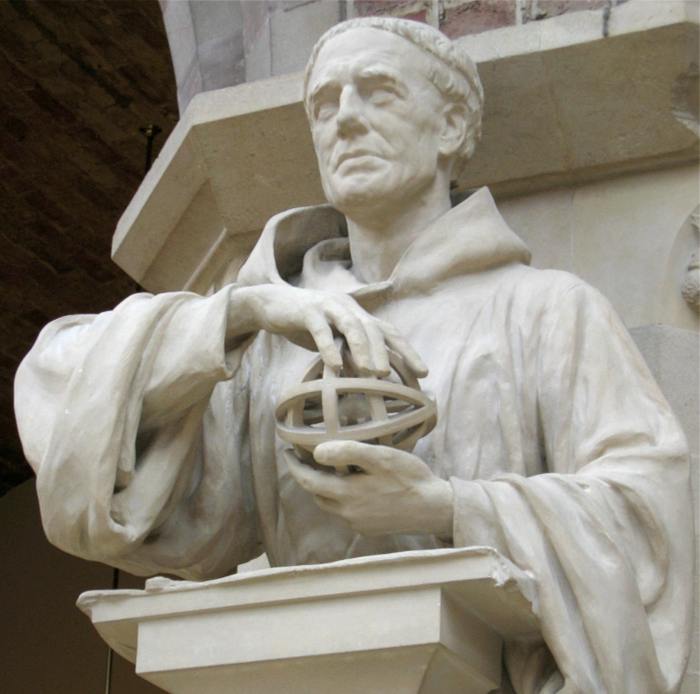
*Statue of Roger Bacon in the
Oxford University Museum of
Natural History.
The next historical figure to make an appearance is Roger Bacon, an English philosopher and Franciscan whom some consider an early champion of the scientific method. Bacon lived from circa 1214 to 1294. Known as Doctor Mirabilis, which means "wonderful teacher," he studied at Oxford and later taught there as well as lecturing at the University of Paris. In his writings, Bacon comments on mathematics, optics, alchemy, astronomy, and astrology. He called for reforms in theology, arguing that the Bible should be placed at the center of study and that scholars should thoroughly understand the languages of their source materials. Posing as a visiting scholar/monk from Ireland, Douglas Flinders-Petrie meets with Bacon in medieval Oxford to acquire his assistance in deciphering the symbols in the skin map.

Turms the Immortal plays a role in Arthur Flinders-Petrie's narrative. Many years previous, when Turms was a young prince, Arthur had been his student. Now the priest-king of the Etruscans, Turms receives omens, foretells the future, and passes judgements for his people. Arthur brings the pregnant Xian-Li to Turms to learn if the child she carries is still alive. Following a divination ceremony, Turms announces to the couple that the child is not only alive but will enjoy a long life. Unlike Thomas Young and Roger Bacon, Turms is not a real person but a deity from Etruscan mythology. Like the Greek god Hermes, Turms is a messenger between the gods and humans as well as the god of trade. The deity's role as a messenger seems appropriate to Turms the Immortal's role as a soothsayer.

Many critics make a career of speculating about and tracking down a writer's sources. While researching Turms, I came across a novel by Mika Waltari, a Finnish writer of historical novels, titled The Etruscan (1956). The story traces the amazing life of Lars Turms the immortal in ancient Greece and Rome. I haven't read Waltari's novel so I can't speculate on the connection between Waltari's Turms and Lawhead's Turms, but the coincidence is intriguing.

Flinders Petrie, in Jerusalem (1930's).
Sir William Matthew Flinders Petrie (1853-1942) was an English archeologist and Egyptologist who pioneered systematic methods and artifact preservation. Early in his career he surveyed various Roman and stone-age sites in England then traveled to Egypt to apply the same methods to the ancient Egyptian monuments. During his long career, Flinders Petrie performed excavations in Egypt and Palestine. He discovered the first mention of Israel in an Egyptian source and trained a generation of archeologists, including Howard Carter. Did the archeologist Flinders Petrie serve as an inspiration for Lawhead's Arthur Flinders-Petrie? Both are explorers, pioneers in new methods, and both have an affinity for Egypt.

Photo Credits:
*Photograph of Roger Bacon's statue taken by Michael Reeve, 30 May 2004. This image is used in accordance with the Creative Commons Attribution-Share Alike 3.0 Unported license.

In conjunction with the CSFF Blog Tour, I received a free copy of The Bone House from the publisher.

Stephen R. Lawhead's website: http://www.stephenlawhead.com/.

To read what other CSFF bloggers are saying, follow the links below.

Noah Arsenault
Red Bissell
Thomas Clayton Booher
Beckie Burnham
Morgan L. Busse
CSFF Blog Tour
Carol Bruce Collett
Karri Compton
D. G. D. Davidson
Theresa Dunlap
April Erwin
Victor Gentile
Tori Greene
Ryan Heart
Bruce Hennigan
Timothy Hicks
Christopher Hopper
Janeen Ippolito
Becca Johnson

Jason Joyner
Julie
Carol Keen
Krystine Kercher
Marzabeth
Katie McCurdy
Shannon McDermott
Rebecca LuElla Miller
Joan Nienhuis
Chawna Schroeder
Kathleen Smith
Donna Swanson
Rachel Starr Thomson
Robert Treskillard
Steve Trower
Fred Warren
Phyllis Wheeler
Nicole White
Rachel Wyant

Monday, October 24, 2011

CSFF Blog Tour: The Bone House Day One

The Bone House
Stephen R. Lawhead's The Bone House is a strange book. It transports the reader to exotic locales in time and place: ancient and nineteenth-century Egypt, Etruscan Italy, medieval England, and somewhere in the stone age, just to name a few. And, Lawhead renders them all in beautiful detail. It poses questions about the philosophical implications of multiverses between which, in Lawhead's fiction, time flows at different rates. While all those attributes cast The Bone House in some very strange and wonderful shadows, they are not the principal reason for designating The Bone House a strange book. The Bone House is of a breed from which many readers cringe in terror. It's a middle book in a series. The action picks up where The Skin Map, the previous book in the series (see my reviews here, here, and here), left off and ends after an appropriate number of pages. New plot lines have been established and new characters introduced, but almost nothing has been resolved. It's the second ley in a series of jumps. The Bright Empires Series is much more a Lord of the Rings type experience than a Narnia experience. So is The Bone House worth reading? Most definitely, but you must read The Skin Map first and be prepared to feel annoyed when you finish the last pages and discover that The Spirit Well will not be available until September 2012.

The Bone House follows intersecting plots centered around six characters: Kit Livingstone, Wilhelmina Klug, Lady Haven Fayth, Arthur Flinders-Petrie, Douglas Flinders-Petrie, and Archelaeus Burleigh. As in the first novel, Arthur's skin map is the prize everyone is seeking as they jump from world to world, occasionally bumping into each other. For readers of The Skin Map, The Bone House answers a number of nagging questions. First, who is Archelaeus Burleigh and why is he such a scoundrel? The short answer is an unhappy childhood. Lawhead traces Burleigh's rise from a rejected bastard of Lord Ashmole to wily street urchin to personal secretary of Lord Gower to celebrated antiques dealer. Lawhead tells Burleigh's story dispassionately, leading one to feel some pity for the boy Burleigh, whose mother became an opium addict, and admire his determination and resourcefulness, but somewhere along the line, something goes wrong with Burleigh. He loses respect for his fellow human beings, who become little more than tools to achieve his ends. His interactions with various women suggest that Burleigh is incapable of love and intimacy.

At the end of The Skin Map, Wilhelmina appears out of nowhere to save Kit and Giles from certain death in an Egyptian tomb. So when did Wilhelmina go from coffee house owner to master ley leaper? A healthy portion of the chapters on Wilhelmina tell that story. Of all the characters, Wilhelmina most comes into her own in this book. She takes over from Cosimo and Sir Henry Fayth as the driving force in the search for the map. She devises the plans and organizes the participants. One comes to the conclusion that she was born in the wrong place at the wrong time. At one point she tells Kit that the first jump from London to Bohemia, which seemed a disaster at the time, is the best thing that ever happened to her. When she thinks about returning to London to wrap up her affairs, she admits that "[t]he plain truth was she missed nothing about London or her mundane, drudging life there" (p. 168).

Douglas Flinders-Petrie is Arthur's great-grandson and several chapters cover his trip to medieval England in his quest to unlock the secrets of the skin map. But wait, readers of The Skin Map say. Didn't Xian-Li, Arthur's wife, die from Nile Fever before the couple had any children? And who removed the skin map from Arthur's body and hid it all over the multiverse? I won't spoil it, but both questions are answered in The Bone House.

Kit continues to muddle through while always managing to land on his feet, to make the right choice at the end of a string of disastrous ones. Don't think, I found myself saying time and time again, just do exactly what Wilhelmina tells you. He's one of those characters you want to grab by the collar and shake some sense into them. For example, when he stumbles into the stone age, Kit tries to escape from a settlement of cavemen in the middle of the night, not considering what might be lurking in the wilderness after nightfall. A bear comes about as close as possible to eating him.

And finally, what of Lady Haven Fayth, who appeared to turn traitor at the conclusion of The Skin Map. Lawhead devotes several chapters to her story and attempts rouse some sympathy for her as we learn about her previous meetings with Burleigh and her life with Burleigh after escaping the tomb. She abandoned her friends when certain death seemed imminent, and in her view, she made an expedient decision, better to be alive and have a fighting chance than dead. How many of us would have done what she did? Lawhead suggests that Haven does not trust or like Burleigh and she does warn Kit and Giles when Burleigh enters the coffee house and hands Henry's journal over to Kit. However, Wilhelmina doesn't trust Haven, and I'm inclined to follow Wilhelmina's instincts.

In conjunction with the CSFF Blog Tour, I received a free copy of The Bone House from the publisher.

Stephen R. Lawhead's website: http://www.stephenlawhead.com/.

To read what other CSFF bloggers are saying, follow the links below.

Noah Arsenault
Red Bissell
Thomas Clayton Booher
Beckie Burnham
Morgan L. Busse
CSFF Blog Tour
Carol Bruce Collett
Karri Compton
D. G. D. Davidson
Theresa Dunlap
April Erwin
Victor Gentile
Tori Greene
Ryan Heart
Bruce Hennigan
Timothy Hicks
Christopher Hopper
Janeen Ippolito
Becca Johnson

Jason Joyner
Julie
Carol Keen
Krystine Kercher
Marzabeth
Katie McCurdy
Shannon McDermott
Rebecca LuElla Miller
Joan Nienhuis
Chawna Schroeder
Kathleen Smith
Donna Swanson
Rachel Starr Thomson
Robert Treskillard
Steve Trower
Fred Warren
Phyllis Wheeler
Nicole White
Rachel Wyant