Pages

Friday, August 19, 2011

Short Stuff Take 8

The Fisherman and the Syren
by Frederic Leighton (c. 1856–1858).

"The Dust of the Earth and the Foam of the Sea," by E. M. Biswell in Mindflights

In beautiful and haunting prose, Biswell tells the story of a dying boy's confrontation with love and immortality in "The Dust of the Earth and the Foam of the Sea." The narrator, Prince Maximilian, is dying of consumption. His mother believes saltwater to be an elixir and has banished him to a palace by the sea with his tutor, the very logical Mr. Alexander, as his only company. He grows weaker every day and passes his hours reading Socrates and Plato with his tutor. "I was too weak for swimming, too old for sandcastles and hope." One morning, he spies a young girl sitting on the palace steps with her feet in the water. She calls herself Hespatia. She is a mermaid, searching for an immortal soul, and asks Maximilian for help. "'If you love me—' she said." But, according to Mr. Alexander's teaching, there is no such thing as love or heaven or souls. Maximilian will return to dust and Hespatia will return to foam. Hespatia remains at the palace for three days and does her best to teach Maximilian to hope and to love someone other than himself. Hespatia and Mr. Alexander stand in contradiction and wage a war of ideas through Maximilian who has never sought beyond his tutor's teachings.

"Do you mean love and heaven when you say fairy tales and lies?" [Hespatia] asked. "If so, I would rather accept my lies than your truth, my foolishness than your wisdom."

"Clear eyes are better than false hope," [Mr. Alexander] said.

"Heaven is real," she said. "And so is love."

Maximilian finds joy in Hespatia's company, and though Mr. Alexander's teachings have a hold over his psyche, Marcus Aurelius' meditations provide little comfort to a dying boy. Who wins the war? You'll have to read the story to find out. It's well worth your time. I'm looking forward to more of E. M. Biswell's stories.


"The Tale of the Emperor’s Sighs," by Elizabeth Hopkinson in Silver Blade Magazine

The twenty-second Emperor of China is despondent. "Day after day, he would look out across his gold-roofed palace and sigh, his hand on his wasted cheek, his eyes filling with tears." His ministers gather to debate and hatch a plan to cure the Emperor of his woes. They order craftsmen to construct an enormous paper lantern with a dish of oil to burn and a basket in which the Emperor can ride. They believe that his spirits will be renewed if he rises above whatever is bothering him. The Emperor embarks on his journey upward. He passes an Abbott living high atop a mountain, greets the princes and princesses in the Palace of the Moon, and then stops when he reaches the Mountain of Paradise. He can rise no higher but his sadness persists. The Enlightened One tells the Emperor that his sadness is concern for the sorrows of the world. He sends the Emperor home on a cloud, telling him it “is made of all the sighs you have given for the sorrow and suffering of others. As long as your compassion continues, it will bear you up, until the time when you return to this mountain." The Emperor returns to earth with a heart filled with purpose. Hopkinson tells a beautiful fable in "The Tale of the Emperor’s Sighs." Her writing has the feel of something ancient and wise. The moral is thoroughly integrated with the plot. What a better place our world would be if every leader shared the concerns of Hopkinson's Emperor.

Tuesday, August 9, 2011

Story Out and Recent News

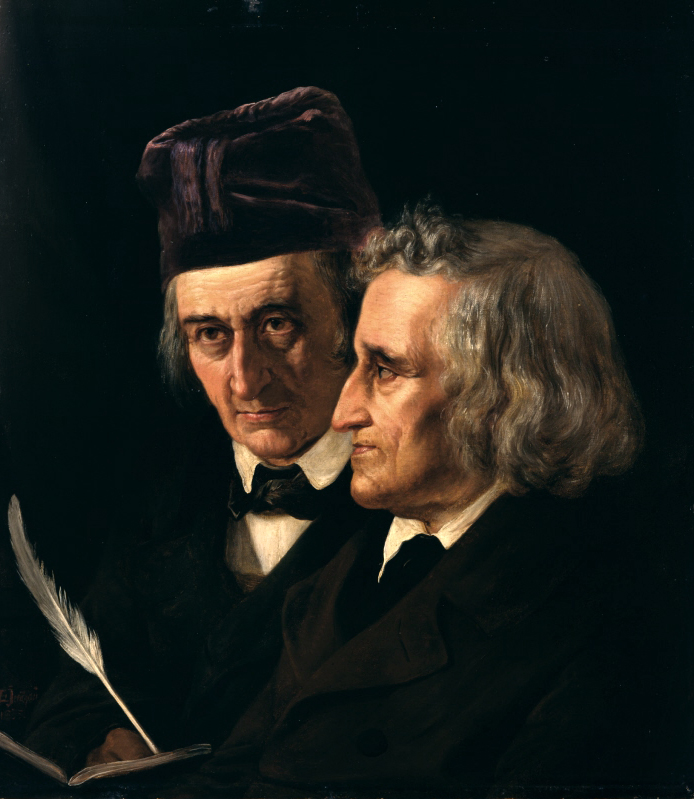
Wilhelm and Jacob Grimm as
painted by Elisabeth Jerichau-Baumann (1855).
My story "The Hand with the Knife" is now available at Mindflights. This story retells the Grimm's fairy tale of the same title about a young girl, her malicious brothers, and an elf with a magical knife. The original, which you can find here, is only a few paragraphs long. My version adds substantial new material and a much more satisfying ending (in my opinion at least). There's also a shape-shifting wolf/man who eats one of the minor characters and a ferocious, wild boar with a penchant for walnuts. Here's an excerpt.

"That's quite a knife you've got there, sis," said Aulden.

"What knife?" Cordelia tucked it among the billowing folds of her skirt, shifting her eyes between her brothers and the outcrop.

The brothers laughed, and while the younger pair held her to the ground and muffled her cries, Aulden wrung the knife from her hand. He examined the runes then tested the blade against a strip of leather that gave way without resistance.

"It's not yours," she said.

"I'm afraid it is, sis. I'm going to say hello to your elf friend. Keep her quiet." Aulden swaggered toward the low hills that marked the trail head.

Cordelia cried out, but the wind carried her warning in the opposite direction and a hand, thick and muscular from farm labor, muffled any further cries. When the elf's hand appeared, Aulden raised the knife and swung it down, a flash of silvery light. The knife sliced through the elf's wrist, severing bone and cauterizing flesh. The elf's deep cry swept across the heath, a cry of betrayal that no wind could divert, the cry of a soul stabbed to the quick. The scream stung Cordelia's ears, ringing on and on as tears welled from her eyes.

In other news, my story "Wilson's Thicket" has been accepted for inclusion in Beneath the Pretty Lies, an anthology from Wicked East Press. The anthology's theme is betrayal and revenge. "Wilson's Thicket" is a contemporary ghost story set in a small town. The protagonist is a junior high boy who witnesses the murder of a teenage girl. At the moment of her death, the girl's spirit enters the protagonist's mind and uses him to carry out her revenge against her killer. The question for the boy is when will her revenge stop?

Monday, August 1, 2011

Recent News

My story "A Mother's Gift" has been accepted by Silver Blade Magazine. The story centers on Queen Thestral, who has suffered four stillbirths. She cannot endure another one and asks a village woman skilled with herbs to guarantee her child's live birth. The herbal woman can offer no such help, only a spell to channel the child's pain to Thestral for the rest of the child's life. Is this a gift or something else? "A Mother's Gift" is slotted for Issue 11, which should be out in mid-August.

Friday, July 29, 2011

Short Stuff Take 7

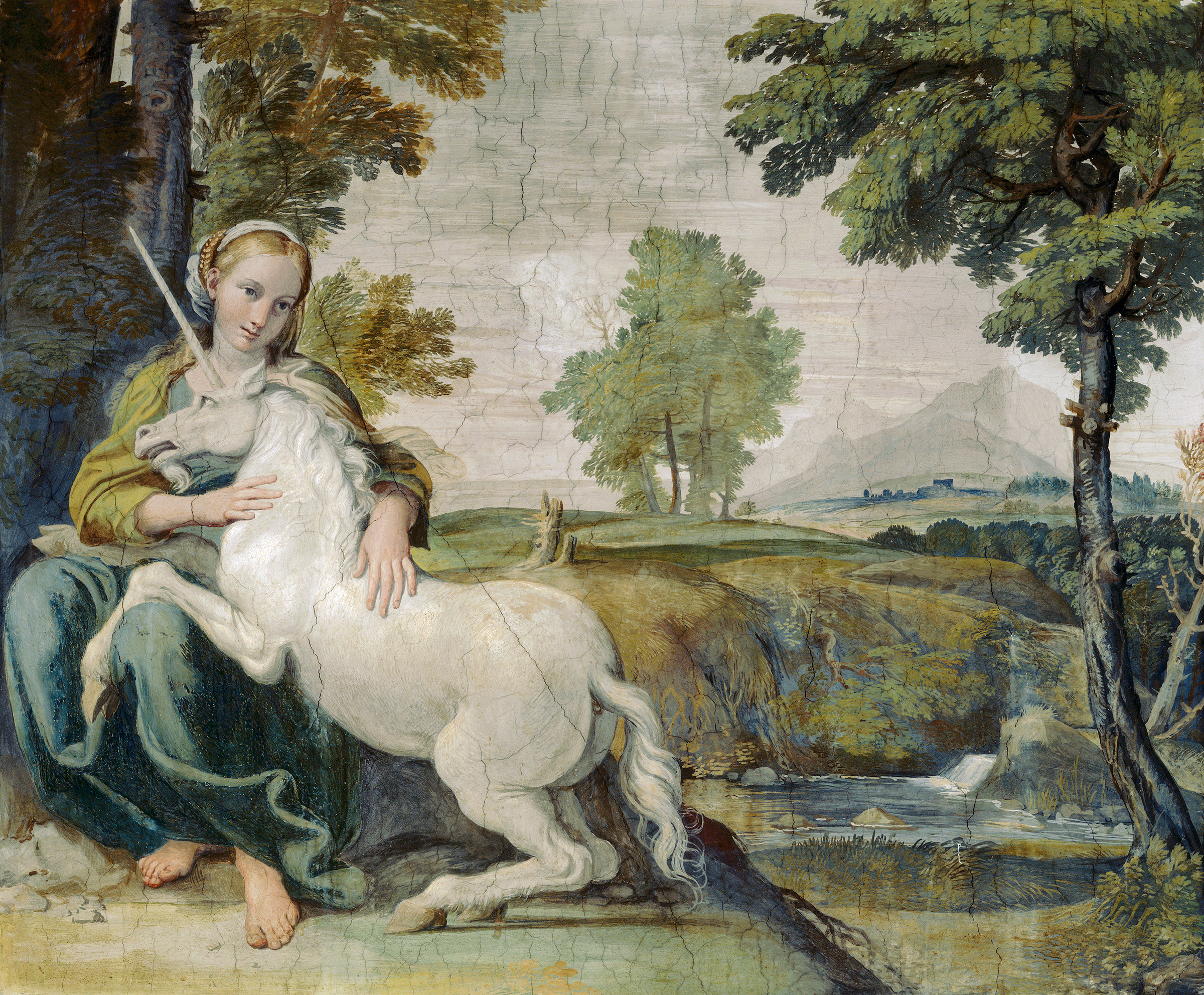
A Virgin with a Unicorn,
c. 1604-05, by Domenichino.
"The Unicorn Hunter," by Matti Lena Harris in Mindflights

Portivaul is looking for a virgin. No, it's not what you think. He needs someone innocent and pure to attract unicorns. Once plentiful in the King's forest, a vast expanse of oaks, the population of unicorns is dwindling from excessive poaching. As a magical animal, every part of the carcass is valuable on the black market. Portivaul claims that he is working for the King, doing a census and evaluation of the unicorn population, at least that what he tells Narissa, the desperate young girl who offers to be his virgin. Narissa agrees to be unicorn bait, not surprising as she was willing to sell herself for three coppers. Portivaul gives her five gold coins as an advance. They catch a glimpse of a unicorn on their first night in the forest and Narissa can talk of nothing else. Portivaul soon wearies of her enthusiasm. The next day, Narissa stands quietly in a clearing while Portivaul hides in a tree with his crossbow. He's told Narissa that the unicorn poachers are dangerous men and he is armed for their protection. A unicorn comes after waiting all day in a cold autumn wind and Narissa is transfixed. Portivaul watches Narissa's reaction and recalls the first time he saw a unicorn as a young boy, baiting them for his father, a unicorn hunter. They find two traps in the clearing. Portivaul says the traps are to break a unicorn's legs so that it can't run away from a hunter. Narissa demands that they hunt the unicorn hunters but Portivaul cautions against it. The next morning, Portivaul finds Narissa and his crossbow gone and begins a desperate search in which he'll find much more than unicorns and an innocent girl. "The Unicorn Hunter" speaks of loss and the power of innocence and the miraculous to overcome it. Narissa turns Portivaul's heart, taking him back to a time when he too appreciated the beauty of creation, embodied in the unicorn, for its own sake.


"For a Handful of Crowns," by Milo James Fowler in Linger Fiction

What if the Soviets had won the Cold War? What if a mysterious green cloud had washed over the United States of the early 1970s, leaving every American dumb, as in unable to speak, and unable to use their feet for walking? What would happen to all the shoe stores? If you're curious and don't mind some disturbing imagery, check out "For a Handful of Crowns." Milo posted on his blog that this story might be too disturbing to read. After hearing that I had to read it. "For a Handful of Crowns" centers on a boy and girl in Soviet-occupied America, crawling around a nursing home filled with desiccated cadavers. They can't talk so they have to use sign language to communicate. They're searching for crowns. I thought at first that crowns referred to British coins, kind of like A Fistful of Dollars, but it actually refers to dental work. They're after the gold which they can trade for food at a Soviet army commissary. All of this is illegal of course but tolerated. I won't spoil the fun by listing all the gross imagery except for one.

Jennifer’s eyes reminded him of cheese. Something about the way they oozed cream while she argued her point, like they were liquefying and he had to quick find some tortilla chips while the stuff was fresh.

This image echos throughout the piece. Is there any hope for people reduced to such desperate circumstances? Is there any hope if they can trade a handful of crowns for some cheese and chips? Maybe.

Wednesday, July 27, 2011

Remarks on The Ale Boy's Feast

The Ale Boy's Feast: A Novel (The Auralia Thread)
I learned a valuable lesson from Jeffrey Overstreet's The Ale Boy's Feast, the final novel in The Auralia Thread. You cannot read a book out of sequence in a series like The Auralia Thread and hope to appreciate it, no matter how many summaries or reviews you read of the previous books. I suspect this series is tightly integrated, more like The Lord of the Rings than the episodic Chronicles of Narnia. What's worse is that The Ale Boy's Feast is the last of the four-book series. All the threads are coming together at this point. It's like reading The Return of the King first. I had reservations when I started but the title sounded so intriguing that I decided to jump in. Like the Ale Boy, I suffered a long fall.

I was supposed to read The Ale Boy's Feast for the CSFF Blog Tour but I didn't finish in time. It took me an extra week. It's not the case that Overstreet's prose is laborious or the story difficult to follow. His prose and imagery are beautiful, the stories (there are multiple plot lines) are engaging, and the characters complex. The difficulty was fitting the parts of the stories together when I did not have first hand knowledge of the previous parts. While the resolution of the plot lines for Auralia, Cal-raven, and Rescue (a.k.a. the Ale Boy) are powerful, I couldn't help but think I was missing out on their significance and power.

The Ale Boy's Feast centers on the quest to find Inius Throan--an ancient, deserted city--where Cal-raven, the former king of House Abascar which is now in ruins, hopes to establish a new House Abascar from the scattered survivors of Abascar and anyone else who wants to join. The ancestors of Cal-raven and his people once lived in Inius Throan. The people of Abascar are scattered, some in captivity and some in exile. The Ale Boy plays a key role in rescuing some of the captives and leading them on a journey across the continent on an underground river. In broad outline, this tale shares some elements with the Exodus story. A downtrodden and defeated people journey through many hardships to return and reclaim their original homeland.

The source of evil in Overstreet's world is the Seers, a group of "fallen angels" who cannot create anything new but are highly skilled at perverting nature. The Seers have cursed the people of House Cent Regus, transforming them into hideous beastmen. They have perverted plants into deathweed, a fast-growing plant that kills people and animals. In their final act of evil, they transform trees into viscorclaws, branches that walk about like spiders and shred people with the points of their legs. The only weapon against the plants is fire and the only cure for the accursed beastmen is a very pure water from a well that has run dry.

I've only scratched the surface with my summary. There are dozens of characters in Overstreet's novel that I've not mentioned and many places--some not so pleasant--that I haven't sketched. I've added the other three books in the series--Auralia's Colors, Cyndere's Midnight, and Raven's Ladder--to my reading list. I want to know how this story began.

In conjunction with the CSFF Blog Tour, I received a free copy of The Ale Boy's Feast from the publisher.

Saturday, July 2, 2011

Stories Out

There Was a Crooked House... (An Anthology of Crooked Stories)Two of my stories have been published in the last week. "The Wand" is available at Golden Visions Magazine for the next three months. You can read it here. "The Crooked House of Coins" appears in There Was a Crooked House... (An Anthology of Crooked Stories) from Pill Hill Press.

Here's an excerpt from "The Crooked House of Coins":
James stared at the scrolling flower reliefs that decorated the ceiling. Across the room, below a newly cleared wall, Nathan snored in his sleeping bag. James thought of Silas, falling or leaping from a window, watching the grass and rocks racing to meet him. Something moved on the ceiling. A vine of filigree slithered into an oval. Flowers contorted to bulging eyes. A single, broad leaf twisted into a mouth while stems with multiple flowers grew to bushy sideburns that edged a balding head. The lips contorted to a scream as the face, translucent and gray, fell toward him. James cried out and rolled into the wall.

Friday, July 1, 2011

Word of the Week: Panic

So what do you think of when you hear the word panic? Do you think of a mob pounding on the doors of a closed bank, fire in a theater, or strange noises in a forest? Panic derives from the French word panique which derives from the Greek word panikon which means literally "pertaining to Pan." As a word for mass terror, panic came into usage in the 17th and 18th centuries. Its association with financial matters dates from the 1750s.

The god of wild places, shepherds, hunting, and rustic music, Pan has the hindquarters, legs, and horns of a goat but the torso, arms, and head of a man. Known for his famous flute and the ability to create groundless fear, people attributed mysterious sounds in the wild that frightened them to Pan. According to mythology, Pan aided Zeus in his battle with the Titans by voicing a horrible sound that frightened the Titans and sent them running. Another story suggests that Pan favored the Athenians at the Battle of Marathon and inspired panic in the hearts of the Persians.