Pages

Thursday, May 20, 2010

Word of the Week: Dunce


How could a word for describing a stupid, slow-witted person be interesting? Read on. The word dunce, first used in the 16th century, derives from the name of the Scottish philosopher and theologian John Duns Scotus (c. 1265-1308). His middle name is a reference to his birthplace, believed to be Duns, in Berwickshire, Scotland. Scotus was an important Franciscan theologian from the High Middle Ages and founded a form of Scholasticism--a method of learning which attempted to reconcile classical philosophy with medieval Christianity--known as Scotism. Beginning in the 14th century, Scotus's works became the standard textbooks in universities. In the 16th century, humanists, reacting against medieval theology, singled out Scotus for ridicule and called any follower of Scotus a Duns or Dunsman. The term later morphed into dunce as its meaning broadened to include any slow-witted person. The word dunce derives from petty name-calling, one school of philosophy deriding another. And here's the kicker. If you're familiar with Duns Scotus's writings today, you are certainly not a dunce.

Friday, May 14, 2010

Word of the Week: Defenestrate

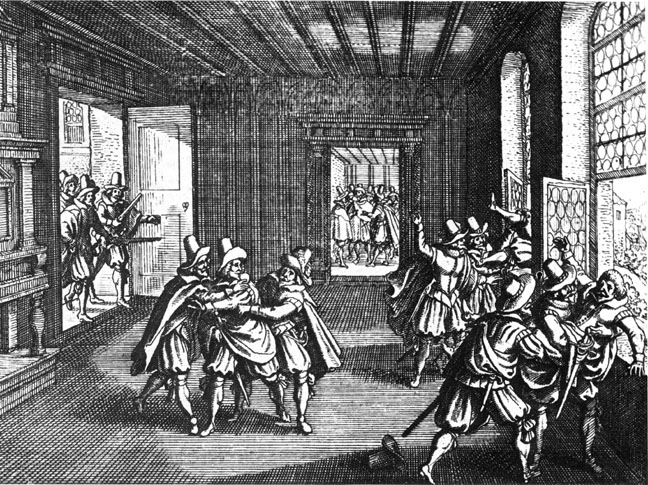
Defenestrate means to throw someone or something out of a window. It can also mean to forcibly or peremptorily dismiss or expel someone from a political party or office. Derived from the Latin words for from de- and for window fenestra, the word has a colorful history, having been coined around 1620 to describe some political events in Prague which came to be known as The Defenestrations of Prague.

The first incident occurred on July 30, 1419 when a Hussite priest led his congregation on a march to the town hall. The peasants were angry over inequities between the lower and upper classes. During the march, a rock, reputedly thrown from the town hall, struck the priest. The mob stormed the hall in response and tossed the judge, the burgomaster, and some members of the town council onto the street. All either died from the fall or at the hands of the mob.

The second incident occurred on May 23, 1618, when a group of Protestants, in response to an inflammatory letter sent by the Emperor's principal adviser to a protestant leader, bribed entry into Prague Castle. They interrupted a meeting of Imperial regents and threw two of the regents and a secretary out a third-floor window. The victims survived, landing in a pile of manure in a dry moat. The emperor later granted the secretary, Philip Fabricius, the title von Hohenfall, which literally means "of Highfall."

While the breaking of glass and death--from the fall and lacerations--may occur from a defenestration, they are not required for a proper defenestration.

Monday, May 10, 2010

Taking a Chance on The Road

The RoadEver read a novel then read some reviews and wonder if you read the same book as the reviewers? That's what happened to me recently after reading Cormac McCarthy's The Road. I haven't read any of McCarthy's other books. None of them sounded all that appealing. The Road, however, has a sci-fi/fantasy feel to it, a story of life in post-apocalyptic America. I seemed to see it everywhere too, at the grocery store, the book store, the library. Everywhere, The Road was staring at me, so I checked out a copy at the library.

There has been some debate about the nature of the disaster. Was it natural--a hunk of space rock hitting the earth--or man-made--a nuclear war. McCarthy never says--it doesn't matter that much to the story--but I think a natural disaster makes more sense. The book never mentions anyone suffering from radiation sickness, and as any dinosaur can tell you, space stuff can cause world-wide devastation. The idea that some disaster would kill off all life except humans did not ring true for me. Flies and cockroaches will surely outlive us and feast on our rotting cadavers.

The story details a father-and-son journey from somewhere in the northern United States to somewhere on the coast of the southern United States. I think. Place names lose their significance when almost everything has been reduced to burnt out shells and ash. Finding something that isn't a pile of ash--a house or fallout shelter with some canned food--is like finding an oasis in the desert. Their survival depends on finding these oases while avoiding the "bad guys," armed groups who have turned to canabalism. The story is riveting as the pair are forever balancing on a knife edge just to survive.

How does one find the strength to go on living in such an environment? The boy was born shortly after the calamity. He has known only a world of devastation. His father tries to tell him what life used to be like. The father tells stories, "Old stories of courage and justice as he remembered them" (p. 41). In a flashback, we are told that the boy's mother lost hope and committed suicide. The father finds meaning in keeping his son alive.

The community has suffered a complete breakdown in mutual trust. Everyone is a potential enemy. Is that person a cannibal or one of the "good guys" trying to survive with some sense of humanity and decency intact. Many of the reviewers on Amazon and some of the blurbs on the book jacket suggest that The Road celebrates the father's love and tenacity. I disagree. The father fails the son, and the son's ultimate survival hinges on understanding that failure.

The father and son meet various individuals and groups on their journey. In a couple harrowing instances, they come close to becoming someone's meal. In the first incident, a truck carrying armed men breaks down where the father and son are hiding along the road. One of the men stumbles on their hiding place and the father shoots him with a pistol. In the other incident, they explore an old house and stumble upon a group of prisoners awaiting slaughter. The father and son barely escape the house before the cannibals arrive to investigate. The father does nothing to help the victims in this case, although to be fair his options are very limited.

In other cases, they meet less threatening people. They see a man who has been struck by lightening stumble across the road. The father assures the boy that there is nothing they can do to help him. Later, they meet an old man shuffling along the road. The boy insists that they give the man some of their food. The father reluctantly agrees. After reaching the coast, their cart, full of provisions, is stolen while they are away from their camp. The pair track down the thief, a single man armed with a butcher knife who is missing all the fingers on his right hand. The father threatens the thief with their pistol, forcing him to remove all his clothes and put them in the cart. The thief begs for mercy and the boy cries, but the father leaves the man naked and shivering on the road. The son continues to cry. The father tries to reason with him but to no avail.

"What do you want to do?"
"Just help him, Papa. Just help him" (p. 259).

The father relents. They can no longer find the man but leave his shoes and clothes on the road. Later that night, the father argues that he had no intention of killing the thief. "But we did kill him" counters the boy (p. 260).

A bit of dialogue toward the end of the story is particularly telling regarding the impact of all these events on the son.

"Do you want me to tell you a story?" [asked the father]
"No."
"Why not?"
The boy looked at him and looked away.
"Why not?"
"Those stories are not true."
"They dont have to be true. They're stories."
"Yes. But in the stories we're always helping people and we dont help people" (pp. 267-8).

Alarm bells should be going off in your head at this point. This conversation is the crux of the story. McCarthy has devoted his life to telling stories so unless he's a major fraud, I seriously doubt McCarthy believes stories have no truth in them. The son realizes that in the interest of survival, the father has thrown out all the lessons from the stories. He is little better than the "bad guys." The father is doing nothing to foster trust or community which is ultimately key to survival.

Eventually the father succumbs to the ash which has poisoned his lungs. Before he dies, the father tells the son:

"Keep the gun with you at all times. You need to find the good guys but you cant take any chances. No chances. Do you hear?" (p. 278). 

This is terrible advice. Taking a chance, trusting someone he doesn't know, is precisely what the boy must do to find the "good guys." After his father's death, the boy meets a man on the road. The man asks the boy to come with him.

"How do I know you're one of the good guys?" [asked the boy]
"You dont. You'll have to take a shot" (p. 283).

The boy takes a chance. He follows the stranger and finds love and security among a new group of people. And there the story ends.

Tuesday, May 4, 2010

Dialogue and Context: The Stuff of Fiction, Part 2

Back to The Stuff of Fiction (2006). In chapter three, Bauer tackles dialogue. This is the best section in the book. If you don't read any of the other chapters, at least grab a copy at the library and read his thoughts on dialogue. Bauer argues that a common mistake of writers is to forget the reader, the person eavesdropping on every exchange between the characters. The dialogue is intended for the reader and must always advance the narrative rather than diminish to meaningless exchanges. When using dialogue, the writer is signaling to readers that important information follows and that the reader should pay close attention. If the dialogue is mundane, the reader will likely decide to go elsewhere. Bauer notes that it is easy to imagine very realistic exchanges between characters that are ultimately pointless to the story. For example:

"I'm home. How are you?"
"Oh, I'm fine. How about you?"
"Great! What's for dinner?"
"Pot roast."
"That sounds yummy."

That does little more than take up space. However, the exchange would take on a whole new level of importance if the answer to the dinner question was not pot roast but the paperboy. In that case you would be contrasting the mundane with the horrific and warrant your reader's attention.

Bauer argues that much of our talk is repetitive and mundane. It's a fallacy to assume that ideal dialogue is a faithful transcript of real talk. He suggests imagining how people talk when they know someone is listening and they are trying to impress the eavesdropper.

Bauer insists that writers must understand the private agenda--set of beliefs and desires--that each character brings to a conversation. Characters do not fully answer questions but do so to the extent it satisfies their personal agendas. The writer must understand how the characters think before he can show the confrontation of their self-interests in their verbal exchanges. Second, good dialogue balances between giving the reader too much and not enough information. The reader "gets enough to sense the general drift, while working to connect the conversational dots; reaching for and grasping the subterranean logic" (p. 47). More is revealed as the dialogue unfolds.
 
The next chapter addresses context. Bauer states that fictional narrative can be divided into two categories: foreground and background. Foreground covers the immediate activity of a scene: the conversation, actions, and thoughts or feelings of characters about what is happening. Background takes in everything else, including past and future events, the history of the locale in which a story is set, and the biographies, personalities, and ambitions of the characters. A story's context is mined from all that background material. Borrowing from E. M. Forster's Aspects of the Novel, Bauer makes a further distinction between story and plot. Story is a string of events arranged in temporal sequence. Plot is a story with the addition of causality. Adding causality, Bauer argues, introduces context. While a story prompts readers to ask "and then what happened", a plot leads readers to ask "why". A plot still needs the forward momentum of a story, but context has enriched it.

To appreciate plot, readers must use their memories and intelligence to make the causal connections. This requirement applies to writers as well. The writer must be always aware of the context the preceding narrative has created. Failing to pay attention to the context will lead to characters doing things that are implausible or impossible. Bauer uses the example of a character who is holding a roast turkey and then gives someone a hug without putting down the turkey. More subtle cases would include characters acting against their beliefs with no explanation of why they have changed their minds. Bauer argues that writers should not consider context a burden but "a generous aid, serving your imagination in helping to present the options open to you as the inventor of a story" (p. 72). 

Lastly, Bauer comments on the earned surprise, the moment during reading "when something is said or something happens that we did not quite see coming" (p. 80). However, for the surprise to be earned, it must fit into the logic and context of the narrative. It must grow out of the context of events and character traits such that on reflection, the surprise is not only credible but inevitable.

Thursday, April 29, 2010

Why No Adverbs?

I recently came across some warnings for fiction writers against using adverbs, those -ly words that modify adjectives and verbs. (I even used one in the previous sentence: recently.) I understand that overuse of adverbs could make your writing look silly and that overuse of any particular tool is to be avoided. However, these writers insisted that adverbs should be shunned, that you should exorcise them from your prose and rewrite any sentence containing one. In short, using adverbs is bad writing for fiction writers. Unfortunately, these writers did not explain why adverbs are bad for fiction. When someone states an absolute rule about language, particularly when they don't explain it, warning signals go off for me. Adverbs shade the meaning of the words they modify. They are grammatical and an accepted part of speech. I've seen them used by well-respected writers. So, what's behind the injunctions against adverbs?

Here's some advice I gathered in my search for the case against adverbs.

Problem #1: Adverbs are redundant when paired with strong verbs. For example: "clenched his teeth tightly"; "moped sadly"; "screamed loudly"; "whispered quietly." In each case, the adverb adds no additional meaning to the verb. There is no other way to mope than with sadness and when someone whispers, they are being quiet.

Problem #2: Writers misuse adverbs to explain dialogue, combining emotions with speaker attributions when those emotions should be clear from the dialogue itself. If the dialogue carries its own weight, adding flying buttresses with adverbs makes it appear weak. For example: "You snapped my pet stick," he said accusingly. The dialogue records an accusation. Nothing is gained from telling the reader again.

Problem #3: Adverbs are used to prop up weak verbs. A better solution is to replace those weak verb/adverb pairings with a stronger verb. For example: replace "frowning angrily" with scowling; "running quickly" with sprinting; "petting softly" with caressing; "moving slowly" with creeping.

Problem #4: Adverbs lead writers to tell rather than show. Instead of telling readers that a character "reads incessantly", show us the stack of books and magazines blocking the door; his reading glasses in the front pocket of his shirt; the many scars from paper cuts crisscrossing his fingers.

Problem #5: Adverbs lead to subtle point-of-view problems. For example, Joe is the POV character but the writer states that "Sue looked at the merchant incredulously." If there is a physical or verbal cue that suggests Sue's attitude, we don't need the adverb. It's redundant. If there is no cue, then we are invading another character's thoughts and momentarily stepping into a different POV.

So, should you ever use an adverb? They are permissible in a few cases. It's reasonable to employ them in dialogue. People use them when they talk. In other cases, an adverb is adequate to create a mental image and rewriting makes the prose wordy. Consider this example: "The man stood silently at the window" versus "The man stood at the window making no noise." The instance with the adverb is more concise. The rewrite is longer and draws unnecessary attention to the phrase "making no noise".

It is very easy to fall into the adverb traps. The good news is that they are easy to find. Search your manuscript for "ly" and consider each instance. You will be surprised how much richer your writing will be when you eradicate those adverbial weeds from your prose. Happy weeding.

Friday, April 23, 2010

Genre

Genre is becoming a four-letter word to me. My hackles raise every time I hear it. According to Merriam-Webster, genre is "a category of artistic, musical, or literary composition characterized by a particular style, form, or content." Fair enough. I have no problem with categorizing literature. Imagine a bookstore or library without any categories. What I do have a problem with is something the dictionary isn't capturing, the word's pejorative use. At a writing conference I recently attended, I overheard someone say that she wonders from what people who read science fiction or fantasy are trying to escape. When I told someone manning a vendor's booth that I write fairy tales and fantasy, she looked at me like I had the plague. Others told me indirectly that they published good fiction but were not open to genre fiction.

It appears many people have bought into a dichotomy that separates fiction into two folders: realistic-literary fiction and genre fiction with all its sub-folders. In addition, many people associate the former with art and the latter with pulp. The definition of genre covers all categories of fiction, including realistic-literary fiction. That's right, realistic-literary fiction is just another genre with it's own particular style, form, and content. At its heart, fiction is about people: their choices, their struggles, their joys, and their sorrows. Good fiction should tell us something about the human condition. Good fiction must also "ring true." The events in the narrative and actions of the characters must be believable within the context of the story. The realistic-literary genre does not have a lock on any of those characteristics or content.

Monday, April 19, 2010

Festival of Faith and Writing 2010

Set This House in Order: A Romance of SoulsLast week I attended the Festival of Faith and Writing at Calvin College. This was my first writing conference. I had no idea what to expect or if it would be worth the registration fee. I'm glad I attended. The experience was invaluable and fun. Some of the presentations directly answered my questions or pointed me in the right direction to build my career. I also made a personal connection with an editor and an agent. This whole business is still about personal connections. If you're seriously interested in writing and publishing, get thee to a conference.

The Miracle Life of Edgar MintI was also introduced to the work of Matt Ruff and Brady Udall. I heard a reading by Ruff from his novel Set This House in Order: A Romance of Souls and attended a session in which he talked about the interior landscapes of his characters. Ruff's Set This House in Order centers on two people with multiple personality disorder. The protagonist builds a house in his mind for the different personalities or souls, as Ruff terms them, to live. Udall gave a presentation on building a novel. That was a great talk, tremendously informative. He offered practical advice on narrative structure and echoed some of the ideas I've come across in John Gardner's works about writing, namely that most literary criticism is not very helpful to writers. Criticism rarely talks about plot structure and how a piece of literature works. So, I added two new books to my ever-growing stack of things to read: Ruff's Set This House in Order and Udall's The Miracle Life of Edgar Mint.

One piece of advice I heard from multiple sources was the importance of blogging and doing it consistently. So, I'm going to make an effort to blog more often.